|
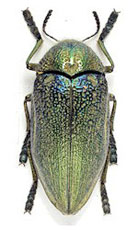
I would like to point out that the taxonomic change from Anthaxia scutellaris to Anthaxia croesus was established in <<Löbl I. et Löbl D., 2016 - Catalogue of Palaearctic Coleoptera. Vol 3. Scarabaeoidea, Scirtoidea, Dascilloidea, Buprestoidea and Byrrhoidea. 2 Ed.>>, with the following motivation: Anthaxia (Haplanthaxia) scutellaris Gené, 1839, reconfirmed syn. of A. (H.) croesus (Villers, 1789). The type material of A. (H.) croesus is missing. Therefore a taxonomic consensus was adopted by V. Kubáň, D. Baiocchi, S. Bílý, T. Kwast and M. Kafka, based on Kiesenwetter’s (1857) concept of A. croesus, the original descriptions and a study of extensive Mediterranean material.
Baiocchi and Magnani later provided a detailed explanation to justify the taxonomic change, in the following paper: <<Baiocchi-Magnani, 2018. A revision of the Anthaxia (Anthaxia) midas Kiesenwetter, 1857 species-group (Coleoptera: Buprestidae: Anthaxiini). Zootaxa 4370 (3): 201–254>>.
I report part of the text of this paper on A. croesus:
"In the careful study of the bibliography of this group, we ascertained that the first unquestionable reference of A. midas sensu lato, was published by Gory & Laporte (1839: 15), who reported this species from south France as A. croesus (Villers).
Some years later, Kiesenwetter (1857: 83) wrote that, in his opinion, A. croesus (Villers) sensu Gory & Laporte was a different species from the species originally described by Villers, and eventually changed its name into A. midas (Kiesenwetter, 1857: 90).
Incidentally, since Kiesenwetter expressed his opinion, the problem of the real identity of A. croesus (Villers) had remained somehow unresolved. In fact, A. croesus auctorum has been widely quoted in literature, always with various incorrect original spellings, and not only in relation to A. midas, but also to various species from different subgenera. Therefore, to avoid confusion, before we deepen the taxonomic history of the A. midas group, it will be appropriate to dedicate a few lines to explain the taxonomical position of A. croesus sensu lato.
It is well known that, at the time of publication of the work by Kiesenwetter, there was no universally recognized taxonomic regulation. Therefore, when Kiesenwetter (1857: 82) synonymized A. (Haplanthaxia) scutellaris (Gené, 1839), A. (H.) viminalis Gory & Laporte, 1839, and A. (H.) fulgidipennis Lucas, 1846 under A. croesus (Villers), his opinion raised a debate on the real identity of A. croesus. The discussion lasted for a long time, becoming in some cases rather controversial. In absence of any illustration of this species in the original work of Villers, various authors speculated on its real taxonomic position, associating it with different species.
Indeed, the few characters outlined by Villers, are objectively applicable to various species from different groups, all with similar patterns of colouration. In the attempt to assert their respective point of view, Kiesenwetter (1857: 83) and Marseul (1865: 230) even discussed at length on the comments made by Villers about the beauty and size of his species, or the alleged hidden meanings of its distribution. Eventually, most of the early authors followed the opinion of Kiesenwetter. Among them, we find Jacquelin Du Val (1861: 141), Redtenbacher (1874: 511), Stierlin (1886: 10), Kerremans (1892: 119, 124; 1903: 174, 176), Fauconnet (1892: 250, 251), Acloque (1897: 277) and others. Jacquelin Du Val (1861: Pl. 25, Fig. 22) also published an illustration of A. croesus (Villers), perhaps the only faithful one ever published. The specimen pictured in his work undoubtedly represents a male of the species formerly known as A. scutellaris, now A. croesus (see Kubáň et al., 2016: 22), and illustrates the typical bent shape of its legs, and its exact pattern of dorsal colouration.
We know that, before his death, Villers had passed his collection to a fellow citizen of Lyon, but since then, there have been no more information about its final destination, and it is presumed to have been destroyed. Nevertheless, it is conceivable that at the time during which Jacquelin Du Val was preparing his work, the collection still existed, and he might have had a chance to see the type, and illustrate it in his work.
Amongst more recent authors who discussed the matter, we find Obenberger (1917: 46, 133), Schaefer (1938: 216) and Richter (1949: 149). Each of them gave a different interpretation, associating A. croesus (Villers) to different forms of A. salicis (Fabricius, 1776), but probably they did not take into consideration the fact that, together with A. croesus, in the same work Villers had separately treated also A. salicis (Villers, 1789: 337).
Schaefer in particular, followed the opinion of Abeille (1904: 217), who had associated A. croesus (Villers) with the species currently known as A. semicuprea Küster, 1852.
In the absence of a recognized type, the various interpretations were destined to remain merely individual speculations, and the problem has long remained unresolved. In modern Catalogues (Bílý, 1997: 61; Bellamy, 2008: 1465), A. croesus (Villers) was still considered a synonym of A. salicis, while A. croesus auctorum (not Villers), was treated as an unavailable name for [i]A. salicis[/i]. In our opinion instead, based on the above, and in particular on the illustration by Jacquelin Du Val, the description of A. croesus (Villers) is more pertinently applicable to A. scutellaris. Therefore, with consensus of some specialists, in the latest edition of the Palaearctic Catalogue, A. croesus (Villers) has been resurrected from synonymy, and A. (H.) scutellaris (Gené, 1839) was reconfirmed as a synonym of A. croesus (Villers) (Kubáň et al., 2016: 22)."
I recall seeing a print of the original color drawing of A. croesus Villiers, and it does indeed appear to depict a specimen of what we know as A. scutellaris. Anyway, the taxonomic change was made and motivated correctly, and any return to the previous nomenclature should be implemented with an appropriate publication, providing justifications.
|